
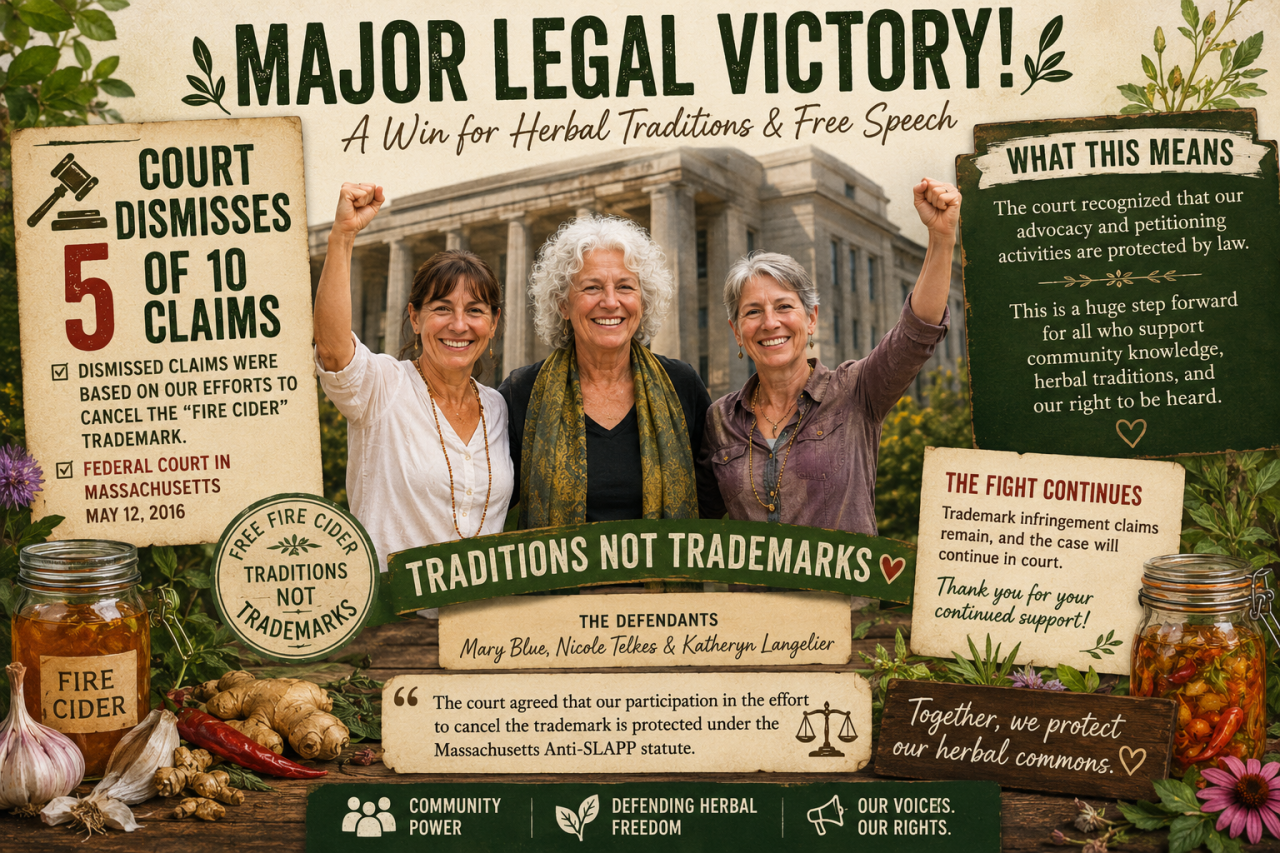
Major Legal Update in the Fire Cider Case
In May 2016, supporters of the Fire Cider movement received encouraging news in the ongoing legal battle surrounding the “Fire Cider” trademark.
A federal court in Massachusetts dismissed five of the ten claims brought against herbalists and advocates challenging the trademark registration, marking an important early victory for the movement and reinforcing protections for public participation and advocacy.
A Significant Court Decision
The lawsuit involved herbalists:
- Mary Blue
- Nicole Telkes
- Katheryn Langelier
The dismissed claims were specifically related to their participation in efforts to challenge and cancel the federal trademark registration for the term “Fire Cider.”
According to the claims, these advocacy activities allegedly caused financial damages to the trademark holder. However, the court ultimately rejected those allegations.
The Role of the Massachusetts Anti-SLAPP Law
The defendants requested dismissal under the Massachusetts Anti-SLAPP statute, a law designed to protect individuals and organizations from lawsuits intended to discourage or punish public participation in government processes.
Anti-SLAPP laws safeguard activities such as:
- Petitioning government agencies
- Participating in public policy discussions
- Advocating for legal or regulatory changes
- Exercising constitutional rights related to free speech and public participation
The defendants argued that their involvement in efforts to challenge the trademark registration fell squarely within these protected activities.
After reviewing evidence and hearing arguments from both sides, the court agreed.
Community Advocacy Played a Role
As part of their defense, the defendants submitted evidence demonstrating the public nature of the movement and its educational and advocacy efforts.
Materials presented included community campaigns, educational resources, and public outreach initiatives supporting the position that Fire Cider was a generic herbal term rather than a proprietary brand name.
The case highlighted how grassroots advocacy efforts can become important evidence when courts evaluate public participation protections.
Support from an Experienced Legal Team
The defendants were represented by the New England law firm Verrill Dana LLP.
Their legal team successfully argued that advocacy related to trademark cancellation proceedings constituted constitutionally protected petitioning activity under Massachusetts law.
The ruling represented an important legal milestone in the broader dispute.
The Case Was Not Yet Over
While the dismissal of five claims represented a major victory, the lawsuit itself continued.
Separate trademark infringement claims remained active and would proceed through the federal court system. Those issues would require additional evidence, legal arguments, and further proceedings before a final resolution could be reached.
Trademark cases involving historical usage, generic terms, and community traditions often take years to fully resolve, and this case would prove no different.
Why This Decision Mattered
The court’s decision provided reassurance not only to the defendants but also to supporters across the herbal community.
It demonstrated that participation in public advocacy campaigns and legal challenges could receive important constitutional protections.
For many observers, the ruling reinforced the principle that individuals and small communities should be able to participate in discussions about trademarks and cultural language without fear of retaliation through litigation.
Looking Ahead
Although many challenges remained, the May 2016 ruling offered momentum and hope to those involved in the movement.
Supporters continued to stand behind the defendants as the remaining claims moved forward, knowing that the fight for the future of Fire Cider was far from over.
The road ahead would still be long, but this decision represented an important step forward in protecting both community advocacy and traditional herbal language.
Traditions, Not Trademarks.