
Author: jytrscrn

  • Trademark Enforcement and Community Response: The Early Fire Cider Debate

    Trademark Enforcement and Community Response: The Early Fire Cider Debate

    Trademark Enforcement and Community Response: The Early Fire Cider Debate

    As the Fire Cider trademark controversy unfolded in 2014, conversations within the herbal community began shifting from questions about trademark registration to concerns about trademark enforcement and its impact on independent herbal businesses.

    For many herbalists, educators, and small producers, the issue was no longer theoretical. Reports began emerging of individual sellers being contacted regarding the use of the term “Fire Cider” in product names, listings, and online marketplaces.

    The debate quickly grew into a national discussion about traditional herbal terminology, intellectual property, and the balance between brand protection and community heritage.

    Reports of Marketplace Trademark Notices

    During this period, several herbal businesses reported receiving requests to remove references to “Fire Cider” from online product listings and search tags.

    One example shared publicly involved an Etsy seller who was contacted regarding product titles and metadata that included the term.

    The communication referenced the existing trademark registration and requested changes to listing terminology to comply with marketplace trademark policies.

    While trademark enforcement actions are common within commercial industries, the situation generated concern because many members of the herbal community viewed Fire Cider as a long-standing generic term rather than a proprietary brand name.

    A Strong Emotional Response

    The herbalist community’s response reflected the deep personal and cultural significance attached to traditional herbal preparations.

    Many practitioners believed the issue extended beyond a single product name and touched on broader questions about ownership, stewardship, and the sharing of traditional knowledge.

    Some community members expressed concern that enforcement efforts directed toward small-scale herbal producers and cottage businesses conflicted with the collaborative values that have historically characterized herbalism.

    For supporters of the movement, the central concern remained the same:

    Who should have the right to use traditional herbal names that have existed within communities for decades?

    The Growth of a Grassroots Movement

    As awareness spread, supporters organized educational campaigns aimed at informing consumers, retailers, and herbal practitioners about the history of Fire Cider and the legal proceedings surrounding the trademark.

    The movement that emerged became known by a simple phrase:

    Traditions Not Trademarks.

    Its goal was to encourage discussion about preserving traditional terminology while respecting both intellectual property law and community heritage.

    Consumer Advocacy and Community Engagement

    Supporters explored a variety of peaceful advocacy strategies that are common within grassroots movements.

    These included:

    • Sharing educational resources.
    • Encouraging informed conversations with retailers.
    • Supporting independent herbal businesses.
    • Raising public awareness through articles and social media.
    • Participating in discussions about trademark policy and traditional knowledge.

    Organizers consistently emphasized respectful communication and encouraged supporters to approach conversations with professionalism and courtesy.

    The Importance of Supporting Local Herbal Businesses

    One of the most significant outcomes of the Fire Cider movement was renewed attention on local herbal producers and community-based businesses.

    Across North America, small herbal companies continued to preserve regional traditions, teach plant medicine, and provide handcrafted products rooted in local knowledge.

    Many consumers chose to support these businesses as a way of strengthening local economies and preserving traditional herbal practices.

    A Larger Conversation About Ownership

    The Fire Cider debate ultimately became part of a broader conversation occurring across many traditional industries:

    How should intellectual property law apply to names, recipes, and practices that developed collectively over generations?

    These questions are not unique to herbalism.

    Similar discussions have emerged in food traditions, agriculture, crafts, and cultural heritage preservation around the world.

    The Fire Cider case became one of the most visible examples within the herbal community.

    Looking Back

    Looking back today, the events of 2014 marked the beginning of one of the most important legal and cultural conversations in modern American herbalism.

    The discussions surrounding Fire Cider encouraged thousands of people to engage with issues they had rarely considered before:

    • What makes a term generic?
    • How are trademarks granted?
    • How can traditional knowledge be protected?
    • What responsibilities come with community stewardship?

    These conversations continue to shape discussions about herbal traditions today.

    Looking Forward

    Regardless of individual perspectives on the legal issues involved, the Fire Cider story demonstrated the passion and dedication of the herbal community.

    It showed that traditions matter deeply to the people who inherit, practice, and share them.

    And it reinforced a principle that guided the movement from the very beginning:

    Herbal traditions thrive when knowledge is shared, communities are supported, and history is preserved.

    Traditions, Not Trademarks.
  • A Bright Morning Message from Rosemary: Hope, Herbs, and the Spirit of Fire Cider

    A Bright Morning Message from Rosemary: Hope, Herbs, and the Spirit of Fire Cider

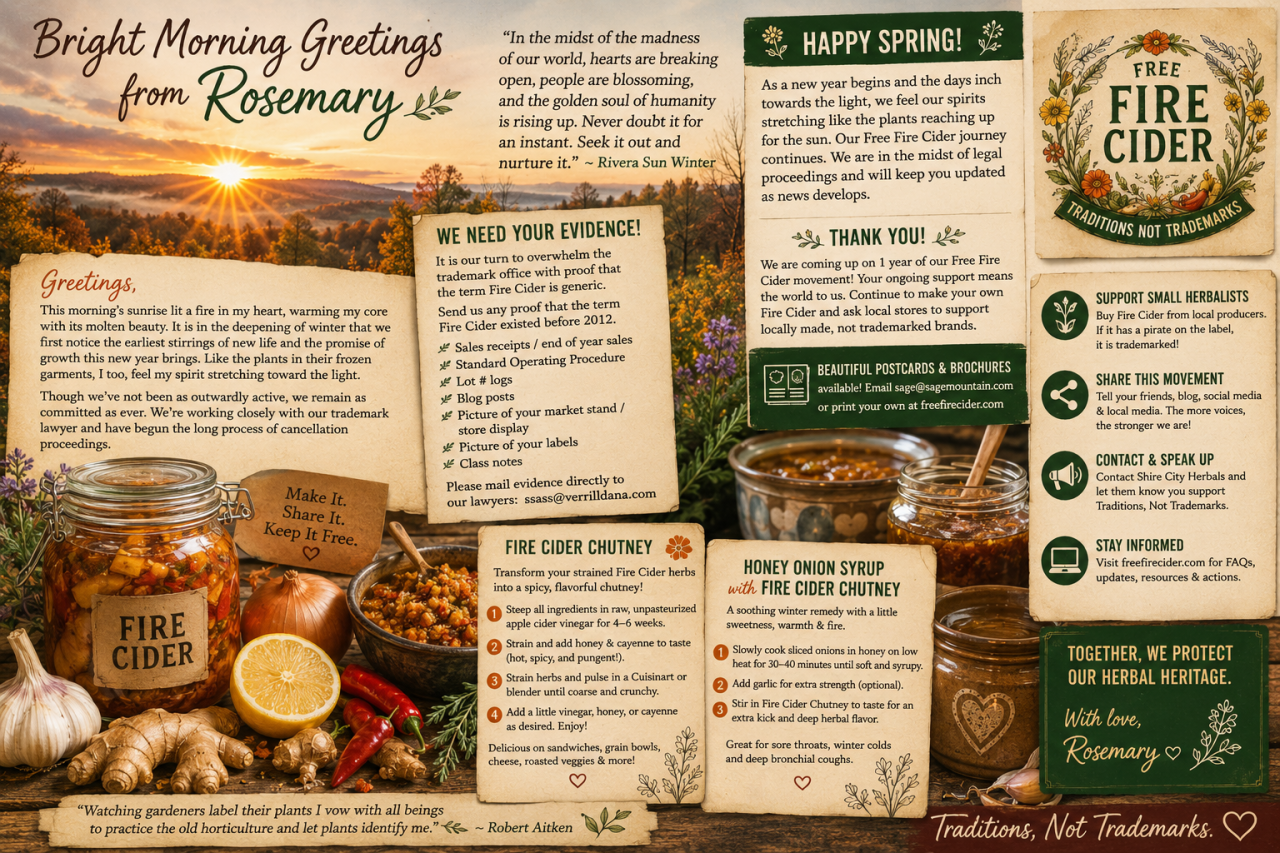
    A Bright Morning Message: Hope, Herbs, and the Continuing Fire Cider Journey

    As winter settles quietly across the landscape and the first hints of longer days begin to appear, there is a certain kind of hope that emerges with the returning light.

    Even in the coldest months, nature reminds us that growth continues beneath the surface. Seeds rest patiently beneath frozen soil, trees prepare quietly for spring, and the cycle of renewal moves steadily forward.

    It is during these moments that many of us find ourselves reflecting on the year ahead and the possibilities it may bring.

    Finding Light During Challenging Times

    In periods of uncertainty and change, it can be easy to focus on division, difficulty, or disappointment. Yet history repeatedly reminds us that communities often grow stronger during moments of challenge.

    Acts of kindness multiply.

    People support one another.

    Traditions are preserved.

    Knowledge is shared.

    The herbal community has long embodied these values through collaboration, mentorship, and generosity.

    As author Rivera Sun beautifully expressed:

    “In the midst of the madness of our world, hearts are breaking open, people are blossoming, and the golden soul of humanity is rising up. Never doubt it for an instant. Seek it out and nurture it.”

    One Year of the Free Fire Cider Movement

    As the Fire Cider movement approached its first anniversary, supporters took time to reflect on how much had already been accomplished.

    Although public updates had become less frequent during periods of legal preparation, work behind the scenes continued steadily. Attorneys, herbalists, educators, and community advocates remained committed to documenting the history of Fire Cider and protecting traditional herbal language.

    The cancellation proceedings had entered a long and complex legal process, one that required patience, persistence, and community support.

    Throughout it all, the commitment remained unchanged:

    To preserve Fire Cider as part of the shared herbal commons.

    How Supporters Could Help

    The movement encouraged supporters to continue participating in simple but meaningful ways:

    • Continue making homemade Fire Cider.
    • Support local herbal producers and small businesses.
    • Share educational resources about the history of Fire Cider.
    • Encourage local retailers to stock locally produced herbal products.
    • Help preserve and document traditional herbal knowledge.

    Small actions, repeated across many communities, can create lasting change.

    Creativity in the Herbal Community

    One of the most inspiring aspects of the movement was the incredible artwork, educational materials, and creative projects shared by supporters.

    Artists donated illustrations, posters, postcards, and educational resources to help spread awareness and celebrate the traditions surrounding Fire Cider.

    These contributions reflected the deep connection between herbalism, storytelling, art, and community identity.

    A Winter Kitchen Tradition

    Winter has always been a season for herbal kitchens.

    As jars of infused vinegars, syrups, teas, and preserves line pantry shelves, herbalists often discover new ways to use ingredients that might otherwise go to waste.

    One such inspiration involved repurposing the strained ingredients from a batch of Fire Cider rather than discarding them after infusion.

    The result was a flavorful and versatile condiment that captured the warming qualities of the original preparation while creating something entirely new.

    Fire Cider Chutney

    After straining a finished batch of Fire Cider, the remaining ingredients often still contain plenty of flavor and character.

    Typical ingredients may include:

    • Garlic
    • Ginger
    • Horseradish
    • Onion
    • Chili peppers
    • Lemon
    • Turmeric

    Instead of composting these ingredients immediately, they can be roughly blended into a coarse chutney or relish that pairs beautifully with roasted vegetables, grain dishes, sandwiches, and winter meals.

    The result is spicy, aromatic, and deeply flavorful.

    Like many traditional kitchen remedies, recipes can be adapted according to personal taste and seasonal availability.

    Honey Onion Syrup with Fire Cider Inspiration

    Another long-standing kitchen tradition combines onions and honey into a soothing syrup often prepared during the colder months.

    Slowly warming sliced onions with honey creates a rich syrup that develops sweetness and complexity over time.

    Adding a small amount of spicy herbal chutney or warming herbs can create an interesting balance of sweet and pungent flavors that many people enjoy during winter cooking.

    As with all homemade herbal preparations, ingredients and intensity can be adjusted to individual preferences.

    Herbal Traditions Continue Through Sharing

    The enduring strength of herbal traditions comes not from ownership, but from sharing.

    Recipes evolve.

    Families adapt ingredients.

    Communities pass knowledge forward.

    Every generation contributes something new while honoring what came before.

    This ongoing exchange of ideas is one of the reasons traditional herbal practices have remained vibrant for centuries.

    Looking Forward

    As another season begins and the wheel of the year turns once again, the Fire Cider movement continues with optimism and gratitude.

    The support of herbalists, farmers, educators, artists, and community members has carried the movement forward and demonstrated the power of collective action.

    The message remains as meaningful today as it was then:

    Protect traditions. Share knowledge. Support community.

  • Spring 2015 Update: Calling for Evidence to Protect the Fire Cider Tradition

    Spring 2015 Update: Calling for Evidence to Protect the Fire Cider Tradition

    Spring 2015 Update: A Community Effort to Preserve Fire Cider History

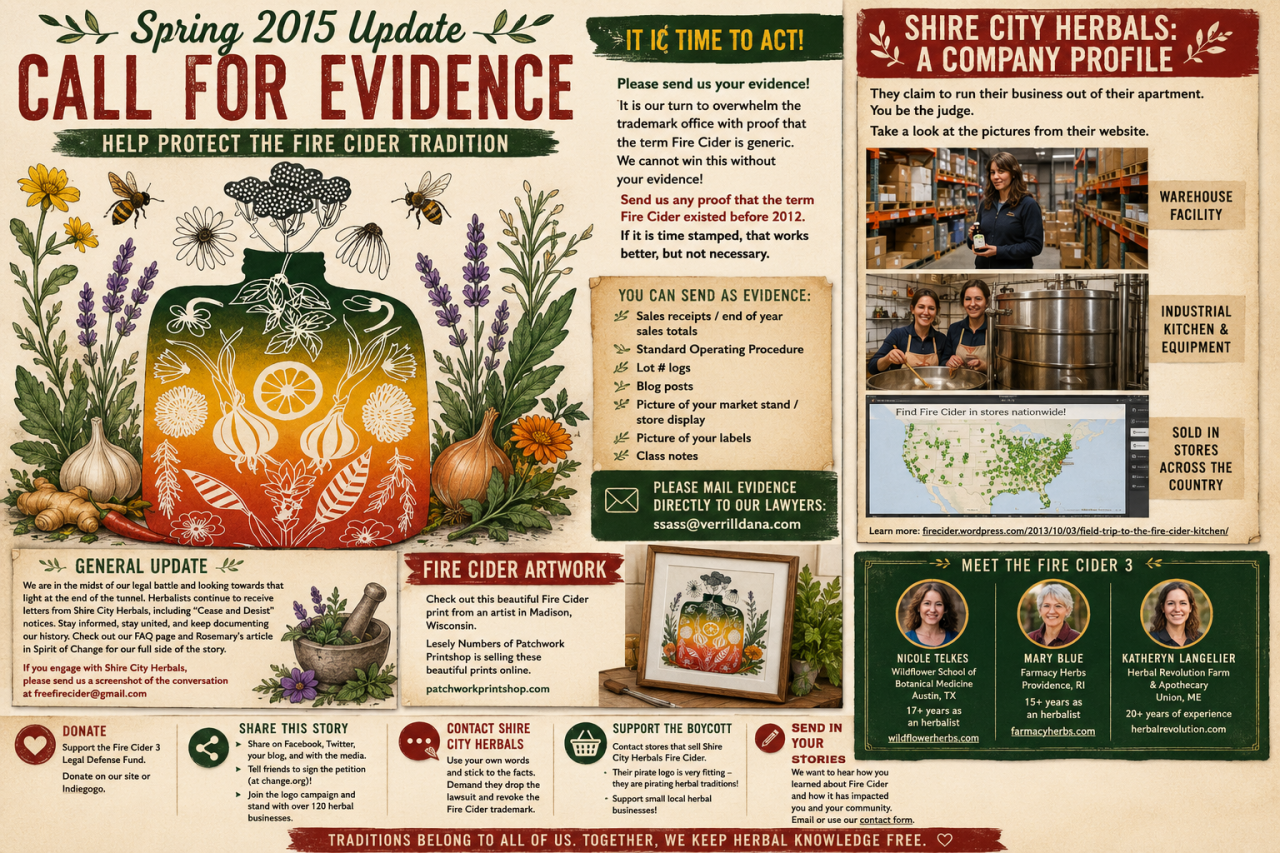
    As spring arrived in 2015, the Fire Cider movement entered one of its most important phases: gathering historical evidence to document the long-standing use of the term “Fire Cider” within the herbal community.

    Supporters, herbalists, educators, farmers, and small businesses across the country were invited to participate in a collective effort to preserve the historical record and demonstrate the widespread use of the name long before trademark registration.

    The message was simple:

    Community history matters, and preserving that history requires community participation.

    A Nationwide Call for Evidence

    The legal proceedings surrounding Fire Cider relied heavily on historical documentation showing that the term had been used in commerce, education, and herbal traditions for many years.

    Supporters were encouraged to search through their records and archives for materials demonstrating earlier use of the term.

    Examples of helpful documentation included:

    • Sales receipts and invoices
    • Product labels and packaging
    • Farmers market displays and photographs
    • Educational materials and class notes
    • Blog articles and newsletters
    • Production records and lot logs
    • Historical recipes and workshop materials

    Even small pieces of evidence could help build a broader picture of Fire Cider’s history within the herbal community.

    Why Historical Documentation Was Important

    Trademark disputes involving generic terms often depend on historical use and public understanding of a name.

    The goal of the evidence-gathering campaign was to demonstrate that Fire Cider had already become a commonly used descriptor for a traditional herbal preparation before trademark protection was granted.

    The response from the herbal community was remarkable, with supporters contributing records spanning decades of herbal practice, education, and commerce.

    An Ongoing Legal Process

    At the time of this newsletter, legal proceedings were still underway and uncertainty remained about how the case would ultimately be resolved.

    Many herbal businesses reported receiving communications related to the trademark dispute and were carefully considering how best to navigate the evolving situation while continuing to serve their communities.

    Throughout the process, the movement emphasized the importance of staying informed, documenting experiences, and supporting one another.

    The Role of Community Dialogue

    As public conversations around Fire Cider continued to grow, organizers encouraged respectful communication and fact-based discussions.

    The movement sought to educate supporters about trademark law, traditional herbal terminology, and the broader implications for community knowledge and shared cultural practices.

    The goal was not simply to win a legal dispute, but to encourage thoughtful conversations about how traditional language and heritage should be protected.

    Celebrating Fire Cider Art and Creativity

    Amid the legal work and evidence collection, the Fire Cider movement also celebrated the creativity that surrounded herbal traditions.

    Artists across the country created prints, illustrations, and educational materials inspired by Fire Cider and the values it represented.

    The featured artwork shown above beautifully captures the spirit of the movement through an arrangement of classic Fire Cider ingredients and medicinal herbs.

    Within the illustration are many of the plants commonly associated with traditional recipes, including:

    • Garlic
    • Onion
    • Ginger
    • Chili peppers
    • Citrus
    • Medicinal flowers and herbs
    • Pollinator-friendly plants

    The artwork serves as a reminder that Fire Cider is more than a recipe—it is part of a living tradition shared through generations of herbalists and home makers.

    Questions About Growth and Scale

    As the conversation expanded nationally, supporters frequently asked questions about the companies and organizations involved in the trademark dispute and the broader herbal marketplace.

    These discussions reflected a growing public interest in how traditional products evolve from local recipes into nationally distributed products and brands.

    The movement encouraged supporters to research the issue for themselves, review publicly available information, and form their own conclusions based on facts and evidence.

    A Community Effort That Made History

    Looking back, the 2015 evidence campaign became one of the defining moments of the Fire Cider movement.

    Thousands of records, stories, labels, photographs, and memories were collected from herbalists across North America.

    Together, these contributions helped document the rich history of Fire Cider and demonstrated the power of community collaboration.

    The campaign showed that preserving traditions is not the work of a single person or organization.

    It is something communities accomplish together.

    Looking Forward

    The spring of 2015 marked the beginning of a new chapter in the Fire Cider story.

    What started as a request for evidence became a nationwide effort to document herbal history, protect shared traditions, and preserve knowledge for future generations.

    The movement’s message remained clear:

    Traditions belong to the communities that create, teach, and preserve them.

    Traditions, Not Trademarks.

  • Herbalists Sued Over the Fire Cider Trademark: The Fight for Traditional Herbal Names Intensifies

    Herbalists Sued Over the Fire Cider Trademark: The Fight for Traditional Herbal Names Intensifies

    Herbalists Sued Over the Fire Cider Trademark

    What began as an effort to protect a traditional herbal term soon became one of the most significant legal battles the American herbal community had ever faced.

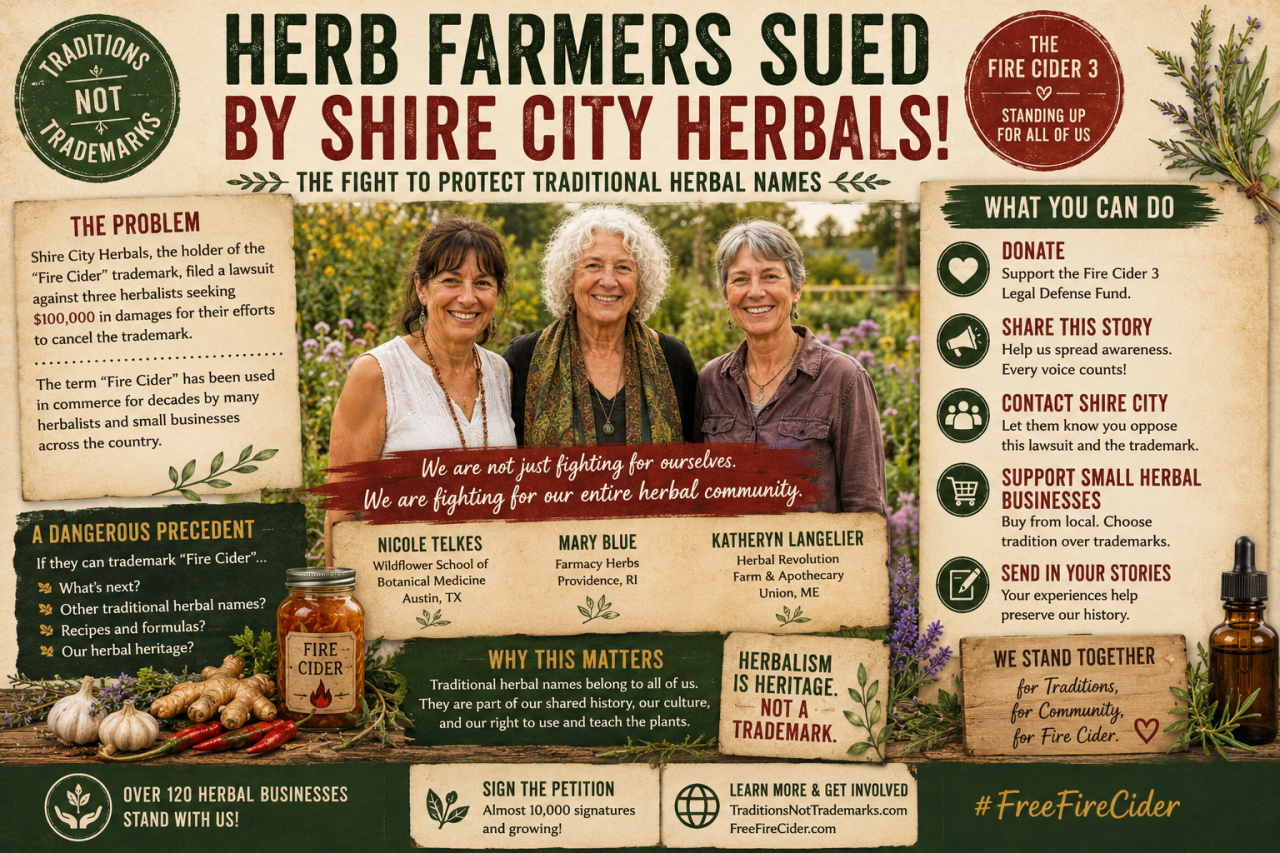
    In 2015, three herbalists involved in the movement to challenge the trademark registration of “Fire Cider” found themselves at the center of a federal lawsuit. Their participation in the effort to preserve a shared herbal tradition had evolved into a national conversation about trademarks, community knowledge, and the future of small herbal businesses.

    The Fire Cider 3

    The herbalists involved in the legal challenge became widely known as the Fire Cider 3:

    • Nicole Telkes
    • Mary Blue
    • Katheryn Langelier

    Together, they represented a larger grassroots movement seeking cancellation of the federal trademark registration for the term “Fire Cider.”

    Supporters argued that the name had been used within the herbal community for decades prior to trademark registration and had become a generic descriptor for a traditional herbal tonic.

    The Trademark Dispute

    The petition to cancel the trademark was filed with the United States Patent and Trademark Office in 2014.

    Advocates supporting cancellation gathered historical records, product labels, educational materials, publications, and testimony intended to demonstrate longstanding public use of the term within the herbal community.

    The central question was simple but important:

    Can a traditional community term become exclusive commercial property if it was already widely used by others?

    A Federal Lawsuit

    As the trademark challenge gained national attention, a separate civil lawsuit was filed against the three herbalists in federal court in Springfield, Massachusetts.

    The lawsuit sought damages related to the defendants’ alleged activities connected to the movement challenging the trademark registration.

    For many within the herbal community, the legal action became symbolic of a broader conflict between traditional knowledge and modern intellectual property protections.

    Legal Representation and Support

    The Fire Cider 3 were represented by attorneys from Verrill Dana LLP.

    Their legal team argued that generic terms and commonly used product names should remain available for public use and that legal mechanisms existed to challenge trademarks believed to have been granted in error.

    The case attracted widespread attention throughout the herbal industry and beyond.

    More Than One Product Name

    Supporters of the movement emphasized that the case extended beyond Fire Cider itself.

    Many feared that if longstanding herbal names could become private trademarks, other traditional recipes and product names might eventually face similar restrictions.

    Questions were raised about the broader implications for traditional foods, beverages, and community knowledge that have historically existed outside of exclusive ownership structures.

    For many observers, the lawsuit represented an important test case for how intellectual property law would interact with cultural and traditional terminology.

    Standing Together as a Community

    The response from the herbal community was immediate and substantial.

    Supporters organized educational campaigns, shared historical evidence, raised awareness through media outreach, and contributed to legal defense efforts.

    Herbal businesses, educators, farmers, and practitioners from across North America publicly expressed support for protecting traditional herbal language and preserving access to commonly used terminology.

    The phrase “Traditions Not Trademarks” quickly became the defining message of the movement.

    Supporting Small Herbal Businesses

    The controversy also highlighted the important role small herbal companies play in preserving plant knowledge, community education, and traditional medicine practices.

    Many supporters encouraged consumers to:

    • Learn about the history of traditional herbal products.
    • Support local herbal businesses and producers.
    • Share educational resources about herbal traditions.
    • Participate respectfully in public conversations surrounding trademark policy and traditional knowledge.

    A Movement Bigger Than a Lawsuit

    The Fire Cider case ultimately became more than a trademark dispute.

    It evolved into a national discussion about ownership, cultural heritage, and the preservation of traditional practices that have been shared across generations.

    Regardless of legal outcomes, the movement succeeded in bringing unprecedented attention to the importance of protecting community traditions and the herbal commons.

    Looking Forward

    The legal battle would continue for several more years, eventually becoming one of the most influential cases in modern herbal history.

    For the Fire Cider 3 and their supporters, the goal remained clear:

    To ensure that traditional herbal names, recipes, and community knowledge remain accessible to the people who created, preserved, and shared them for generations.

  • Protecting Traditional Herbal Names: The Debate Over the “Thieves Oil” Trademark

    Protecting Traditional Herbal Names: The Debate Over the “Thieves Oil” Trademark

    Protecting Traditional Herbal Names: Why the “Thieves Oil” Trademark Sparked Concern

    The herbal community has long relied on shared knowledge, traditional recipes, and names that have been passed down through generations. In recent years, however, concerns have grown about the trademarking of historic herbal names that many practitioners view as part of the public herbal commons.

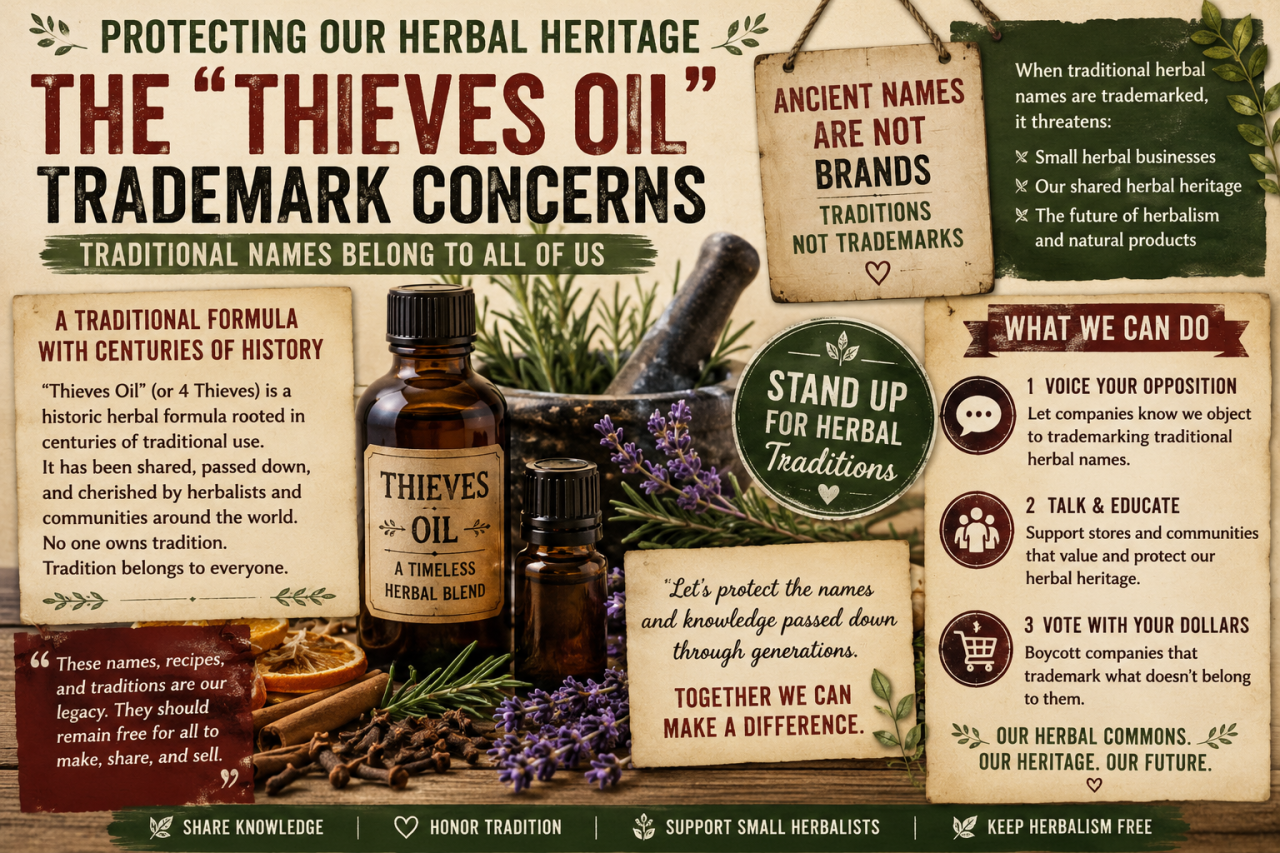
    One example that sparked widespread discussion was the trademark registration and enforcement surrounding the name “Thieves Oil”, a term associated with centuries-old herbal folklore and traditional formulations.

    Why Herbalists Were Concerned

    For many herbalists, the issue extended beyond a single product or company.

    The concern centered on a broader question:

    Can names connected to traditional herbal preparations become exclusive commercial property, even when they have been used within the community for generations?

    The discussion became especially important following earlier disputes involving other traditional herbal terms such as Fire Cider, raising fears that additional long-standing names could face similar restrictions.

    Many herbal practitioners worried that if historical names became unavailable for general use, small businesses could face significant challenges marketing products they had made and sold for years.

    Reports of Trademark Enforcement

    Community concern increased after reports emerged that small herbal businesses had received notices related to the use of terms associated with traditional herbal products.

    One widely discussed example involved a small herbal seller offering a vinegar preparation inspired by the historic “Four Thieves Vinegar” tradition. The seller reportedly received a trademark complaint that resulted in the removal of a product listing from an online marketplace.

    For many in the herbal community, this highlighted the practical consequences that trademark disputes can have for independent producers and small businesses.

    A Broader Conversation About Herbal Traditions

    The discussion surrounding the Thieves Oil trademark became part of a larger movement focused on protecting traditional herbal language and preserving access to community knowledge.

    Herbalists emphasized that their concerns were not necessarily directed at specific companies or products, but rather at the long-term implications of trademarking names that many consider part of shared cultural heritage.

    The movement argued that herbal formulas, recipes, and names that have existed for decades—or even centuries—should remain accessible to everyone who continues to make, teach, and share them.

    What Supporters Advocated For

    Members of the herbal community encouraged several forms of constructive engagement:

    1. Share Your Perspective

    Supporters encouraged respectful communication with businesses and organizations involved in trademark disputes to express concerns about the ownership of traditional herbal terminology.

    2. Support Independent Herbal Businesses

    Many community members emphasized the importance of supporting small herbal companies and local producers who continue to preserve and share traditional knowledge.

    3. Promote Education and Awareness

    Educating consumers, retailers, and fellow practitioners about the history of traditional herbal products was viewed as an important step toward protecting community traditions.

    4. Make Purchasing Decisions That Reflect Your Values

    Some individuals chose to support businesses whose practices aligned with their views regarding traditional knowledge and community ownership of herbal terminology.

    Why This Conversation Matters

    The discussion surrounding the Thieves Oil trademark highlighted a growing challenge facing many traditional communities:

    How should intellectual property law interact with cultural traditions, shared recipes, and historical terminology?

    While trademark law plays an important role in protecting brands and preventing consumer confusion, communities also continue to debate how best to preserve names and practices that predate modern commercial use.

    The herbal community has increasingly referred to this concept as protecting the Herbal Commons — the shared language, traditions, and knowledge that have been freely exchanged and preserved across generations.

    Looking Ahead

    The conversations sparked by both the Thieves Oil and Fire Cider trademark disputes continue to influence discussions about herbal traditions today.

    For many practitioners, these cases reinforced the importance of documenting herbal history, educating new generations of herbalists, and remaining engaged in conversations about how traditional knowledge should be protected.

    The central message remains unchanged:

    Traditional herbal knowledge grows strongest when it is shared, preserved, and passed forward responsibly for future generations.


  • Major Legal Victory: Court Dismisses Five Claims Against the Fire Cider Defendants

    Major Legal Victory: Court Dismisses Five Claims Against the Fire Cider Defendants

    Major Legal Update in the Fire Cider Case

    In May 2016, supporters of the Fire Cider movement received encouraging news in the ongoing legal battle surrounding the “Fire Cider” trademark.

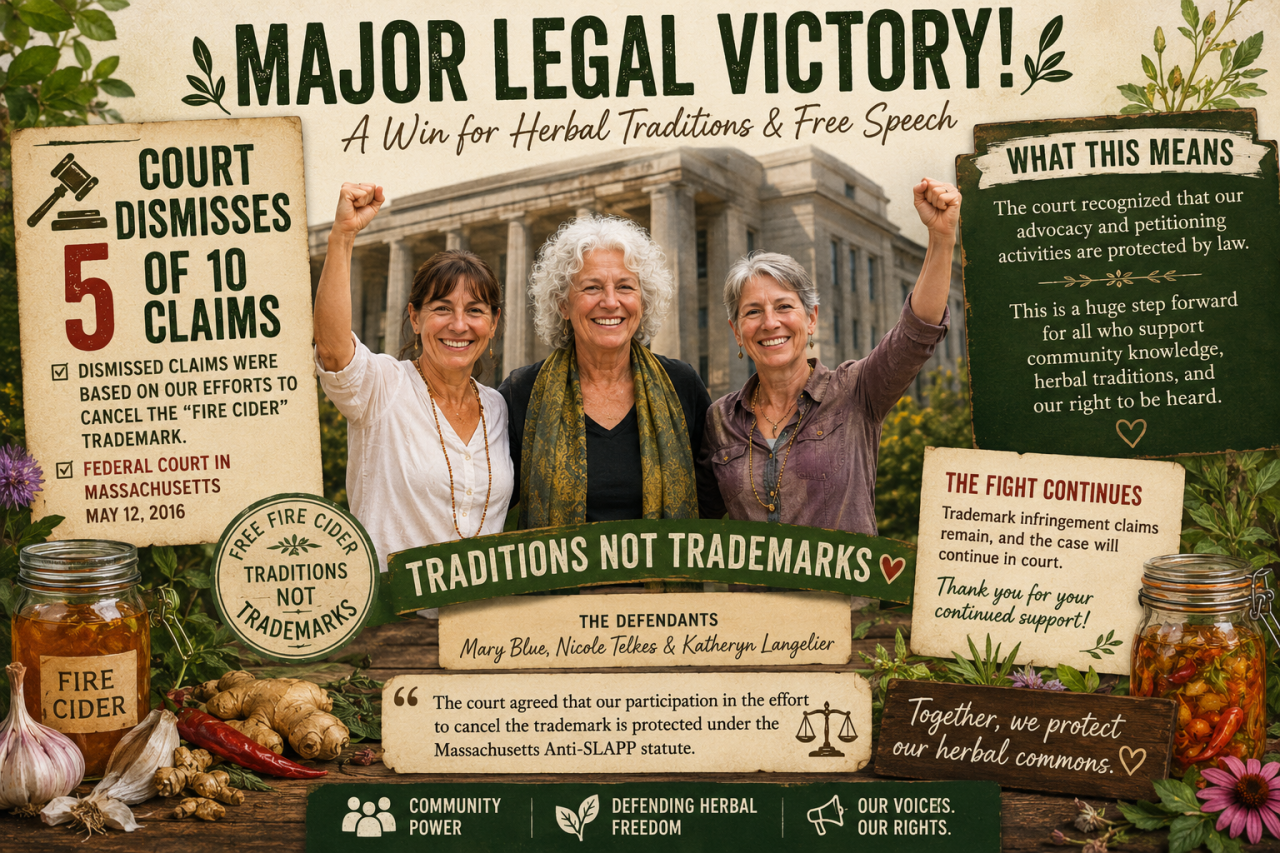
    A federal court in Massachusetts dismissed five of the ten claims brought against herbalists and advocates challenging the trademark registration, marking an important early victory for the movement and reinforcing protections for public participation and advocacy.

    A Significant Court Decision

    The lawsuit involved herbalists:

    • Mary Blue
    • Nicole Telkes
    • Katheryn Langelier

    The dismissed claims were specifically related to their participation in efforts to challenge and cancel the federal trademark registration for the term “Fire Cider.”

    According to the claims, these advocacy activities allegedly caused financial damages to the trademark holder. However, the court ultimately rejected those allegations.

    The Role of the Massachusetts Anti-SLAPP Law

    The defendants requested dismissal under the Massachusetts Anti-SLAPP statute, a law designed to protect individuals and organizations from lawsuits intended to discourage or punish public participation in government processes.

    Anti-SLAPP laws safeguard activities such as:

    • Petitioning government agencies
    • Participating in public policy discussions
    • Advocating for legal or regulatory changes
    • Exercising constitutional rights related to free speech and public participation

    The defendants argued that their involvement in efforts to challenge the trademark registration fell squarely within these protected activities.

    After reviewing evidence and hearing arguments from both sides, the court agreed.

    Community Advocacy Played a Role

    As part of their defense, the defendants submitted evidence demonstrating the public nature of the movement and its educational and advocacy efforts.

    Materials presented included community campaigns, educational resources, and public outreach initiatives supporting the position that Fire Cider was a generic herbal term rather than a proprietary brand name.

    The case highlighted how grassroots advocacy efforts can become important evidence when courts evaluate public participation protections.

    Support from an Experienced Legal Team

    The defendants were represented by the New England law firm Verrill Dana LLP.

    Their legal team successfully argued that advocacy related to trademark cancellation proceedings constituted constitutionally protected petitioning activity under Massachusetts law.

    The ruling represented an important legal milestone in the broader dispute.

    The Case Was Not Yet Over

    While the dismissal of five claims represented a major victory, the lawsuit itself continued.

    Separate trademark infringement claims remained active and would proceed through the federal court system. Those issues would require additional evidence, legal arguments, and further proceedings before a final resolution could be reached.

    Trademark cases involving historical usage, generic terms, and community traditions often take years to fully resolve, and this case would prove no different.

    Why This Decision Mattered

    The court’s decision provided reassurance not only to the defendants but also to supporters across the herbal community.

    It demonstrated that participation in public advocacy campaigns and legal challenges could receive important constitutional protections.

    For many observers, the ruling reinforced the principle that individuals and small communities should be able to participate in discussions about trademarks and cultural language without fear of retaliation through litigation.

    Looking Ahead

    Although many challenges remained, the May 2016 ruling offered momentum and hope to those involved in the movement.

    Supporters continued to stand behind the defendants as the remaining claims moved forward, knowing that the fight for the future of Fire Cider was far from over.

    The road ahead would still be long, but this decision represented an important step forward in protecting both community advocacy and traditional herbal language.

    Traditions, Not Trademarks.

  • The Fire Cider Trial Begins: A Defining Moment for Herbal Traditions

    The Fire Cider Trial Begins: A Defining Moment for Herbal Traditions

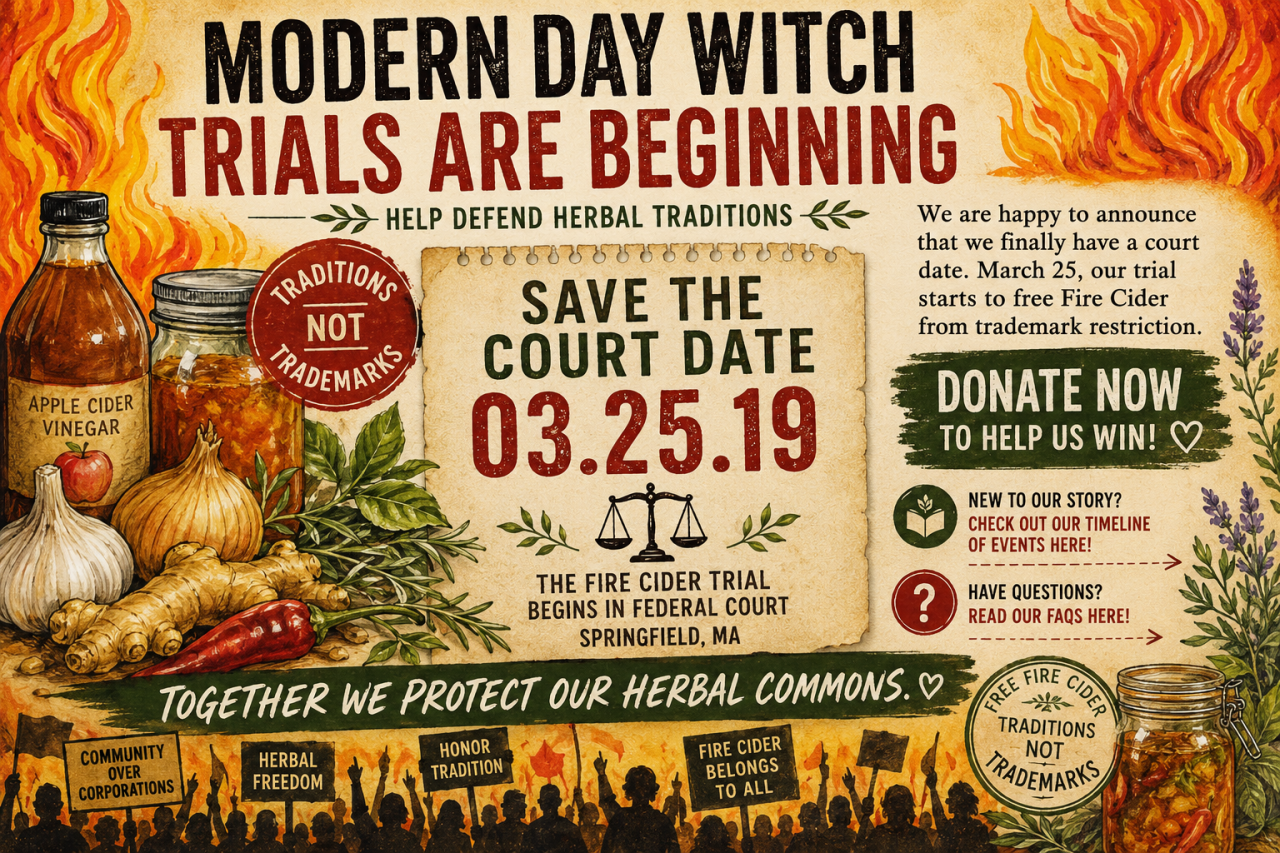
    The Fire Cider Trial Begins: March 25 Marks a Historic Day

    After years of advocacy, legal preparation, and community support, the wait was finally over.

    The Fire Cider trademark case was officially scheduled to begin on March 25, 2019, marking the start of what would become one of the most significant legal battles in modern herbal history.

    For herbalists, educators, farmers, and small businesses across the country, this was about far more than a name. It was about protecting a tradition, preserving shared language, and defending community knowledge that had been passed from one generation to the next.

    Why This Trial Matters

    Fire Cider has long been recognized within the herbal community as a traditional herbal tonic made from ingredients such as apple cider vinegar, ginger, garlic, onions, peppers, and various herbs and spices.

    The upcoming trial would determine whether the term could remain part of the public herbal commons or continue under trademark restrictions.

    For many supporters, the case represented a broader conversation about who owns traditional knowledge and whether commonly used community terms should remain accessible to everyone who has shared and preserved them.

    A Community Comes Together

    As news of the court date spread, support poured in from herbalists and supporters throughout the United States.

    The movement united educators, herbal schools, farmers, practitioners, customers, and small businesses around a common goal: protecting the language and traditions of herbal medicine.

    The phrase “Traditions Not Trademarks” became a rallying cry for a community determined to stand together.

    Preparing for Federal Court

    The trial would take place in federal court in Springfield, Massachusetts, where evidence, historical records, and witness testimony would be presented over multiple days.

    Members of the herbal community prepared to travel, testify, and share the long history of Fire Cider as a traditional herbal preparation.

    The outcome would not only affect Fire Cider but could also influence how courts view traditional names and generic terms used within specialized communities in the future.

    Supporting the Fight

    Legal battles are long, complex, and expensive, especially for small businesses and independent practitioners.

    Community support played a critical role in making it possible for the case to move forward. Contributions helped cover legal expenses, travel costs, research, and preparation for the trial ahead.

    Every donation, message of encouragement, and act of support strengthened the movement and reminded those involved that they were not standing alone.

    New to the Story?

    If you’re discovering the Fire Cider story for the first time, understanding the history behind the case helps explain why so many people rallied behind this effort.

    The journey spans years of community organizing, legal challenges, and advocacy aimed at preserving traditional herbal terminology for future generations.

    Looking Ahead

    March 25, 2019, was more than just a court date.

    It marked the beginning of a historic effort to protect a shared cultural tradition and ensure that community knowledge remained accessible to the people who created, taught, and preserved it.

    The herbal community entered the courtroom with determination, hope, and the support of thousands standing behind them.

    The next chapter of the Fire Cider story was about to begin.

    Traditions, Not Trademarks.

  • The Fire Cider Trial Ends: Awaiting a Historic Verdict

    The Fire Cider Trial Ends: Awaiting a Historic Verdict

    The Trial Is Over – Now We Wait

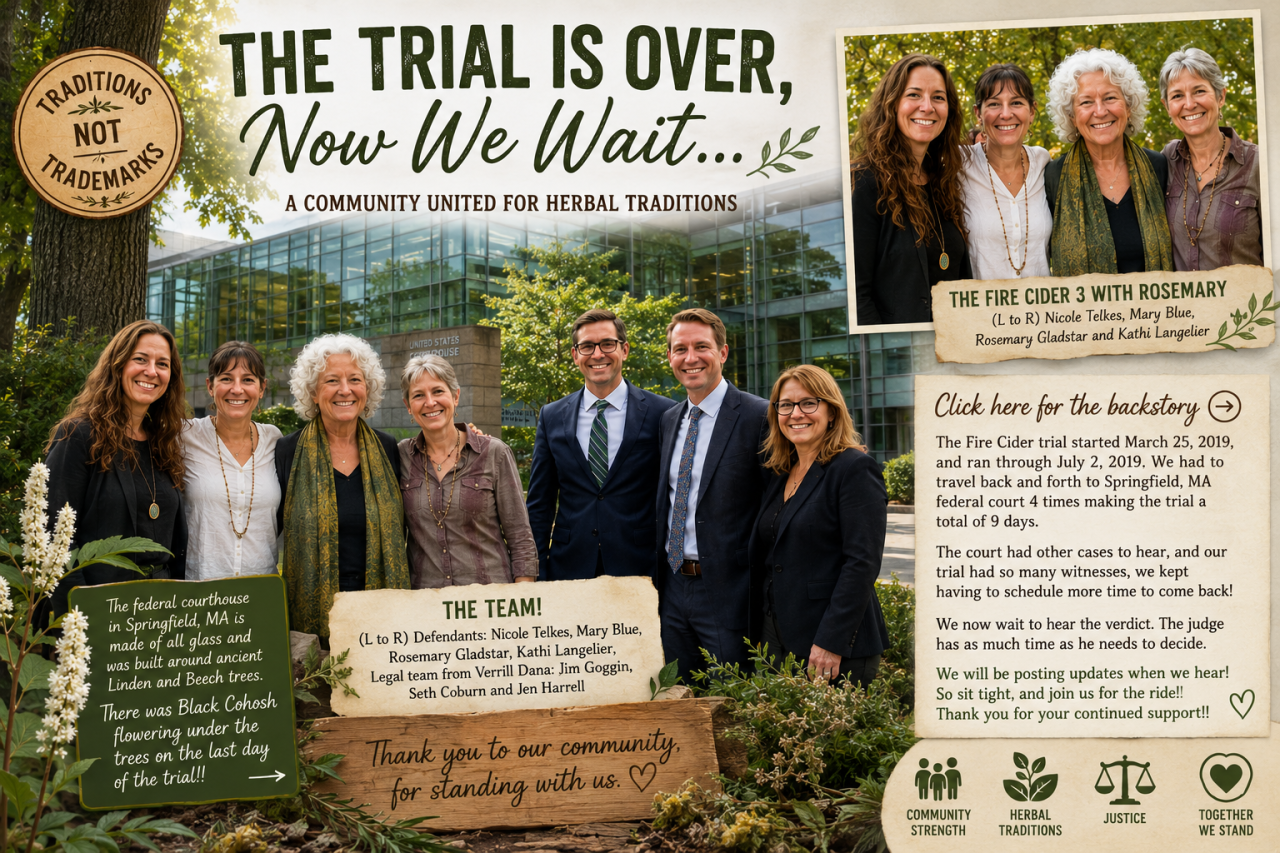
    After years of preparation and months of legal proceedings, the Fire Cider trademark trial officially came to a close in the summer of 2019. With testimony complete and arguments presented, the next chapter was one of patience as the herbal community awaited the court’s decision.

    For those involved, the journey had already become a defining moment in the effort to protect traditional herbal language and community knowledge.

    The Team Behind the Fight

    At the center of the case were the herbalists known as the Fire Cider 3, supported by legendary herbal educator Rosemary Gladstar and a dedicated legal team.

    The group included:

    • Nicole Telkes
    • Mary Blue
    • Kathi Langelier
    • Rosemary Gladstar

    Representing them throughout the case was the legal team from Verrill Dana LLP:

    • James Goggin
    • Seth Coburn
    • Jen Harrell

    Together, they spent years preparing evidence and testimony to demonstrate the longstanding use of Fire Cider as a generic herbal term.

    Nine Days in Federal Court

    The Fire Cider trial began on March 25, 2019, in federal court in Springfield, Massachusetts.

    What was expected to be a shorter process quickly expanded as witness testimony and evidence continued to grow. The parties ultimately traveled back and forth to Springfield on four separate occasions, resulting in a total of nine trial days spread across several months.

    The court’s schedule, combined with the large number of witnesses willing to testify, required additional hearing dates to ensure every voice could be heard.

    By July 2, 2019, testimony had concluded, and the trial officially came to an end.

    Waiting for the Decision

    With the proceedings complete, attention turned to the court’s final ruling.

    Federal judges are given the time necessary to carefully review testimony, evidence, legal arguments, and historical records before issuing a decision. As a result, there was no immediate timeline for a verdict.

    The herbal community entered a period of anticipation, hopeful that the court would recognize the historical and generic use of Fire Cider within herbal traditions.

    Supporters across the country continued following updates and standing alongside the Fire Cider team during this final stage of the journey.

    A Courthouse Surrounded by Nature

    An unexpected symbol of the case could be found just outside the courthouse itself.

    The federal courthouse in Springfield was designed with large glass walls built around mature Linden and Beech trees that had stood on the property long before the building existed.

    On the final day of the trial, supporters noticed Black Cohosh blooming beneath the trees, a plant deeply respected within herbal traditions.

    For many in attendance, it felt like a fitting reminder of the living traditions they had gathered to defend.

    The Community Waits Together

    Although the trial had ended, the story was far from over.

    The outcome would not only determine the future of the Fire Cider trademark dispute but could also influence how traditional names and shared cultural language would be treated in future cases.

    Until the court reached its decision, supporters remained united, hopeful, and ready for the next chapter.

    The herbal community had already proven one thing beyond doubt:

    Traditions are strongest when communities stand together to protect them.

    The verdict would arrive several months later, ultimately becoming one of the most significant legal victories in modern herbal history.

  • Fire Cider Wins: Court Rules “Fire Cider” Is a Generic Herbal Term

    Fire Cider Wins: Court Rules “Fire Cider” Is a Generic Herbal Term

    Fire Cider Victory: A Historic Win for Herbal Traditions

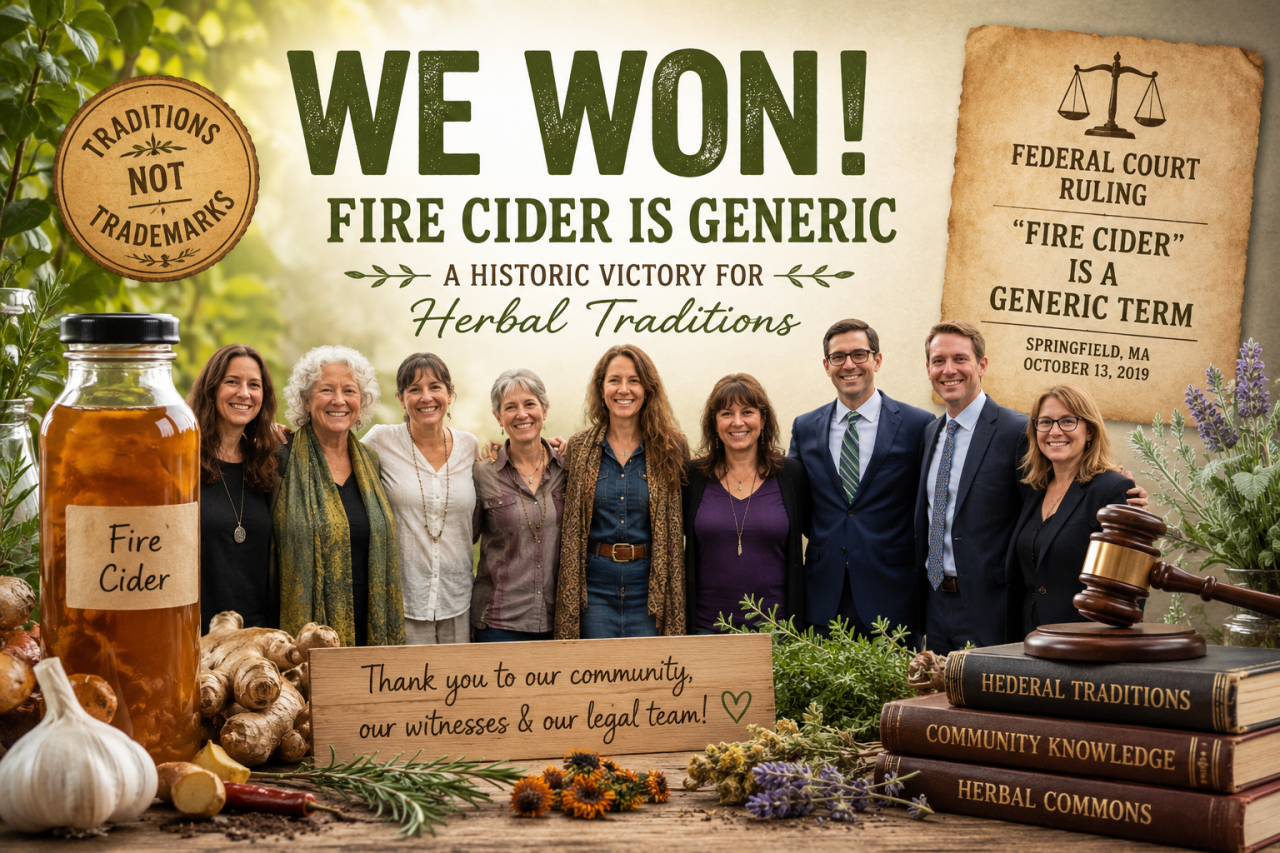
    In October 2019, the herbal community celebrated a landmark legal victory that reaffirmed the importance of protecting traditional knowledge and shared cultural language. After years of legal proceedings, a federal court ruled that “Fire Cider” is a generic term, not a privately owned trademark.

    This decision marked a major milestone for herbalists, small businesses, educators, and traditional medicine advocates across the United States.

    A Long Journey Comes to an End

    The case centered around three herbalists affectionately known as the “Fire Cider 3”:

    • Kathi Langelier of Herbal Revolution in Maine
    • Mary Blue of Farmacy Herbs in Rhode Island
    • Nicole Telkes of Wildflower School of Botanical Medicine in Texas

    Their federal trial took place in Springfield, Massachusetts, lasting nine days and involving years of preparation, research, testimony, and support from members of the herbal community nationwide.

    After reviewing the evidence, Judge Mark Mastroianni issued a detailed 40-page decision concluding that Fire Cider had long been used as a common name for a traditional herbal preparation and therefore qualified as a generic term.

    Why This Decision Matters

    The ruling extended far beyond one recipe or one product name.

    By recognizing Fire Cider as a generic term used within the herbal community, the court established an important legal precedent: a term does not need to be widely recognized by the general public to be considered generic. If a relevant community has historically used a term commonly and descriptively, that usage matters.

    This principle provides valuable protection for traditional practices, community knowledge, and shared cultural language.

    The decision has since become an important reference point for future disputes involving attempts to trademark longstanding community terminology.

    The Strength of the Herbal Community

    The outcome was made possible through years of collaboration, advocacy, and support from herbalists, educators, farmers, customers, and supporters across the country.

    Witnesses traveled long distances to testify, community members attended court proceedings, prepared meals, offered encouragement, and stood in solidarity throughout the case.

    The experience created lasting friendships and demonstrated the resilience and unity of the herbal community.

    Gratitude to the Legal Team

    The Fire Cider 3 were represented by the Portland, Maine-based law firm Verrill Dana LLP.

    Their legal team dedicated years of work to researching the history of Fire Cider and presenting evidence demonstrating its longstanding generic use within the herbal tradition.

    Their efforts played a critical role in securing this historic outcome.

    Looking Ahead

    Following the court’s decision, efforts continued to formally complete the trademark cancellation process with the United States Patent and Trademark Office.

    The broader vision emerging from the case included:

    • Creating a reference library of generic herbal terms.
    • Building an “Herbal Commons” to help preserve traditional language.
    • Encouraging thoughtful research before attempting to trademark names connected to long-standing traditions and community practices.
    • Supporting respectful stewardship of herbal knowledge for future generations.

    A Victory Shared by Many

    The Fire Cider decision was not simply a legal victory; it was a community victory.

    It demonstrated what can happen when individuals come together to defend traditions, protect shared language, and preserve access to cultural knowledge.

    The movement’s message remains as relevant today as it was in 2019:

    Traditions, Not Trademarks.

    Together, the herbal community helped ensure that Fire Cider remains a name that belongs to everyone who has made, taught, shared, and celebrated this traditional herbal remedy for generations.

    Originally celebrated on October 13, 2019, this decision remains one of the most significant legal victories for the modern herbal movement.