
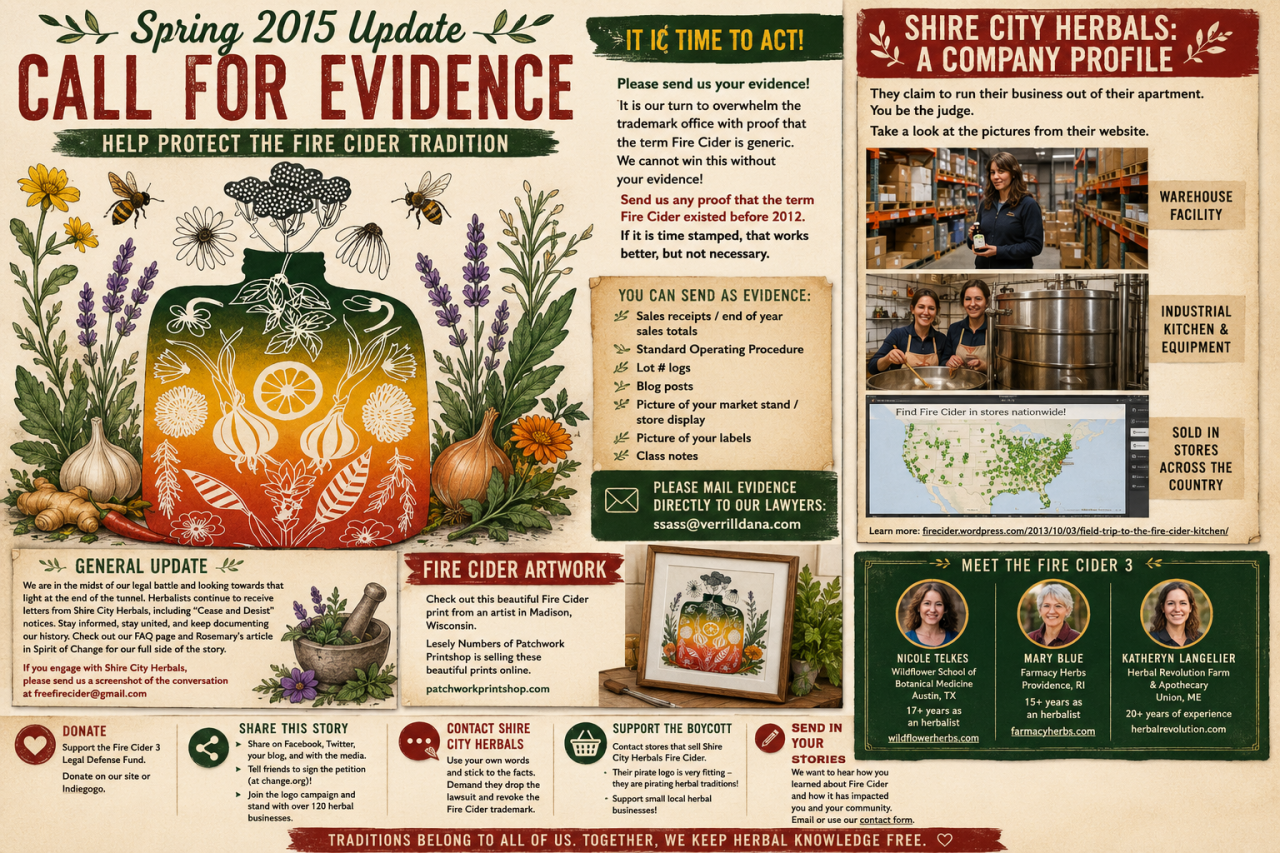
Spring 2015 Update: A Community Effort to Preserve Fire Cider History
As spring arrived in 2015, the Fire Cider movement entered one of its most important phases: gathering historical evidence to document the long-standing use of the term “Fire Cider” within the herbal community.
Supporters, herbalists, educators, farmers, and small businesses across the country were invited to participate in a collective effort to preserve the historical record and demonstrate the widespread use of the name long before trademark registration.
The message was simple:
Community history matters, and preserving that history requires community participation.
A Nationwide Call for Evidence
The legal proceedings surrounding Fire Cider relied heavily on historical documentation showing that the term had been used in commerce, education, and herbal traditions for many years.
Supporters were encouraged to search through their records and archives for materials demonstrating earlier use of the term.
Examples of helpful documentation included:
- Sales receipts and invoices
- Product labels and packaging
- Farmers market displays and photographs
- Educational materials and class notes
- Blog articles and newsletters
- Production records and lot logs
- Historical recipes and workshop materials
Even small pieces of evidence could help build a broader picture of Fire Cider’s history within the herbal community.
Why Historical Documentation Was Important
Trademark disputes involving generic terms often depend on historical use and public understanding of a name.
The goal of the evidence-gathering campaign was to demonstrate that Fire Cider had already become a commonly used descriptor for a traditional herbal preparation before trademark protection was granted.
The response from the herbal community was remarkable, with supporters contributing records spanning decades of herbal practice, education, and commerce.
An Ongoing Legal Process
At the time of this newsletter, legal proceedings were still underway and uncertainty remained about how the case would ultimately be resolved.
Many herbal businesses reported receiving communications related to the trademark dispute and were carefully considering how best to navigate the evolving situation while continuing to serve their communities.
Throughout the process, the movement emphasized the importance of staying informed, documenting experiences, and supporting one another.
The Role of Community Dialogue
As public conversations around Fire Cider continued to grow, organizers encouraged respectful communication and fact-based discussions.
The movement sought to educate supporters about trademark law, traditional herbal terminology, and the broader implications for community knowledge and shared cultural practices.
The goal was not simply to win a legal dispute, but to encourage thoughtful conversations about how traditional language and heritage should be protected.
Celebrating Fire Cider Art and Creativity
Amid the legal work and evidence collection, the Fire Cider movement also celebrated the creativity that surrounded herbal traditions.
Artists across the country created prints, illustrations, and educational materials inspired by Fire Cider and the values it represented.
The featured artwork shown above beautifully captures the spirit of the movement through an arrangement of classic Fire Cider ingredients and medicinal herbs.
Within the illustration are many of the plants commonly associated with traditional recipes, including:
- Garlic
- Onion
- Ginger
- Chili peppers
- Citrus
- Medicinal flowers and herbs
- Pollinator-friendly plants
The artwork serves as a reminder that Fire Cider is more than a recipe—it is part of a living tradition shared through generations of herbalists and home makers.
Questions About Growth and Scale
As the conversation expanded nationally, supporters frequently asked questions about the companies and organizations involved in the trademark dispute and the broader herbal marketplace.
These discussions reflected a growing public interest in how traditional products evolve from local recipes into nationally distributed products and brands.
The movement encouraged supporters to research the issue for themselves, review publicly available information, and form their own conclusions based on facts and evidence.
A Community Effort That Made History
Looking back, the 2015 evidence campaign became one of the defining moments of the Fire Cider movement.
Thousands of records, stories, labels, photographs, and memories were collected from herbalists across North America.
Together, these contributions helped document the rich history of Fire Cider and demonstrated the power of community collaboration.
The campaign showed that preserving traditions is not the work of a single person or organization.
It is something communities accomplish together.
Looking Forward
The spring of 2015 marked the beginning of a new chapter in the Fire Cider story.
What started as a request for evidence became a nationwide effort to document herbal history, protect shared traditions, and preserve knowledge for future generations.
The movement’s message remained clear:
Traditions belong to the communities that create, teach, and preserve them.
Traditions, Not Trademarks.